Screens & Behavior
End Screen-Time Screaming and Bargaining Without Shouting or Snatching the Device
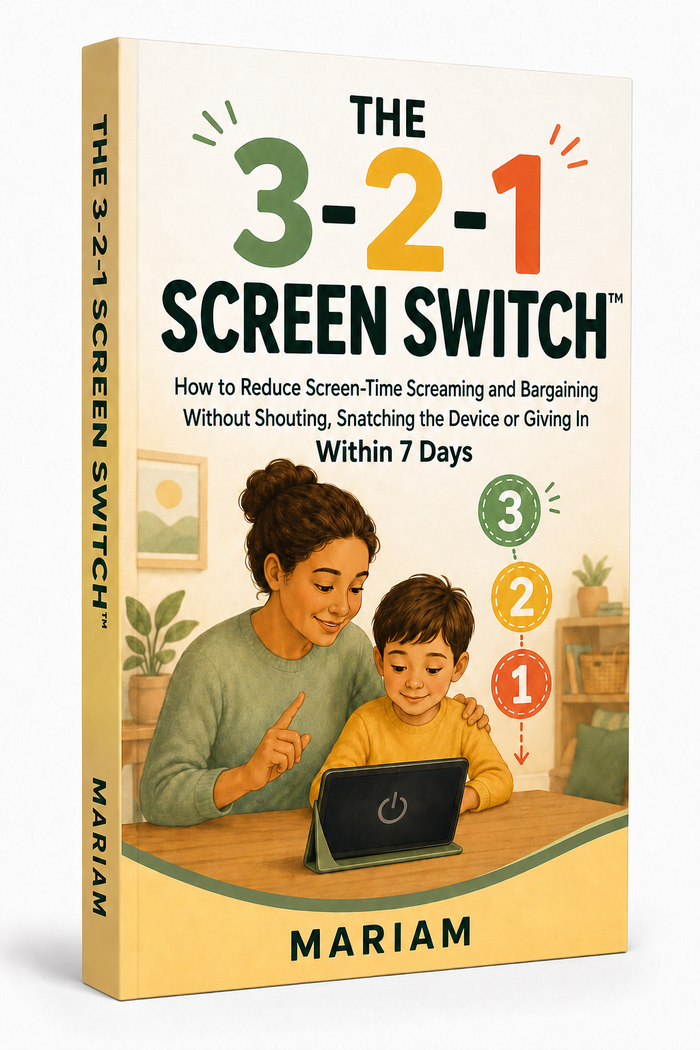
The 3-2-1 Screen Switch is a practical 7-day guide for parents of children ages 4–8 who want calmer, more predictable screen-time handovers.
LIMITED-TIME LAUNCH PRICE
$15.99 $11.99
GET THE GUIDE FOR $11.99Guide + all 3 bonuses · One-time payment · Instant PDF downloadSecure Payhip checkout · Pay by card or PayPal · Instant email delivery
For parents of children ages 4–8 · Read on phone, tablet or computer
If your child screams, cries, or bargains every single time the tablet or phone goes off, and you have started to dread that moment more than any other part of the day, please read every word on this page.
You know the moment I mean.
The show is ending. The game is about to be paused. And your whole body tenses, because you already know what is coming.
"Just five more minutes."
You say no. And the room changes.
The whining. The negotiating. The tears that seem to come from nowhere. Sometimes the throwing. Sometimes a full meltdown on the floor that leaves you standing there, drained, wondering how a cartoon ended with both of you upset.
You have tried everything, being firm, being kind, counting down, hiding the device, setting timers that get ignored the second they go off. You have tried taking it away cold and paid for it with an hour of chaos. And on the hard days, you have just given in, handing it back to buy ten minutes of peace, then feeling that quiet guilt afterward because you know it teaches them that screaming works.
But here is the part nobody talks about. The worst part isn't the noise.
It's what it does to the way you feel about your own child. The moment "screen time" stops being a treat and becomes the thing that ends your evening in tears. The moment you catch yourself snapping at a five-year-old and think, this isn't who I want to be.
That was me. For a long time.
I know exactly how that feels. Because I lived it in my own home first.
My name is Mariam.
I am not a child psychologist. I am not a pediatrician, a "parenting expert," or a coach with letters after my name. I am a parent who spent far too long dreading the same five minutes every day, the moment the screen goes off.
For a long stretch, screen time in my house didn't end. It detonated. It didn't matter how sweet the day had been, the second the device went off it was like flipping a switch, instant tears, instant bargaining. I tried everything the internet told me to, timers, warnings, charts, the calm voice and then the loud one I'm not proud of, and ended up feeling like the problem was me, because none of it stuck.
The truth is, most advice tells you what to want ("set boundaries," "be consistent") but never the one thing that actually matters: how to make the handover itself calm. That specific moment. The transition. That was the thing nobody was teaching, and it was quietly wearing me down.
Where This Actually Came From
I'll be honest about how I found this, because it isn't a magic story.
It came from paying attention to one thing I had been missing: my child was never melting down over the screen. They were melting down over the surprise of it ending.
Every single blow-up happened the same way, the ending arrived suddenly. One second they were deep inside a game or a show, fully absorbed. The next second it was gone, with no runway, no warning their body could actually feel, and nothing to land on afterwards. To a young child, that isn't "screen time is over." It feels like something they love is being yanked away without warning.
Once I saw that, everything changed. The problem was never the screen. It was the hand-off. The way we go from screen to no-screen.
Here is the whole idea in one line:
A child's brain doesn't switch off a screen the way we flick off a light. It needs a runway to land, a few clear signals that the end is coming, a small sense of control over how it ends, and something calm to move into next.
Take that runway away, and you get a crash landing every time: the tears, the bargaining, the meltdown. Give the runway back, and the same child who screamed yesterday can hand the tablet over today without a fight.
The screaming was never the child being "difficult." It was a crash landing, and crash landings are preventable.
So I built a simple sequence around that one insight. I tested it in my own home, on my own hardest days, and it worked. Then I passed it to my sisters, a few close friends, and some parents in my church and community who were quietly fighting the same battle every evening. Same result, calmer handovers, fewer tears. Enough of them came back and told me it had helped that I stopped wondering whether it was just luck in my own house.
That's when I decided to stop passing it around in voice notes and write it down properly, so any parent could follow it step by step. That sequence is what I want to show you now.
The 3-2-1 Screen Switch™
Everything I learned is built into one simple sequence you can start using tonight. It's called the 3-2-1 Screen Switch, and the name is the method:
- 3Three advance signals, small, specific cues you give before the screen ends, so the ending never arrives as a shock. Your child's body starts landing the plane before the wheels ever touch down.
- 2Two handover choices, two simple, controlled choices you offer at the moment of the hand-off, so your child feels a sense of control instead of having something ripped away. This is the piece that quietly ends most of the bargaining.
- 1One calming reset, one short, easy thing you both move into right after, so there's somewhere soft to land instead of an empty, screenless void that begs to be filled with a tantrum.
That's it. Three signals, two choices, one reset.
It takes no special equipment. It works with the devices you already have and fits into the two minutes around the hand-off, the exact two minutes currently blowing up in your face.
No shouting, no snatching the device away, no giving in, and no bribing with sweets or extra time you'll regret.
It is calm, it is repeatable, and once your child learns the rhythm of it, they start to anticipate the landing, which is when the evenings genuinely change.
What Usually Changes, and Roughly When
I want to be careful here, because every child is different and I'm not going to promise you a miracle on a specific day. But there's a pattern I saw in my own home and heard back from my sisters and friends, and it tends to go like this.
The first day or two, it can feel a little clunky. You're learning a new rhythm and so is your child. That's normal, you're replacing a habit that's been running for months. Don't judge it by day one.
Somewhere around the middle of the first week, most parents notice the first real shift. The handover that used to end in tears ends in a grumble instead. Smaller. Shorter. Then one evening it ends with no tears at all, and you almost don't notice until afterwards.
By around a week in, the goal is simple: the screaming and bargaining are far less frequent and far less intense, and the hand-off stops being the moment you dread. Not a perfect robot child, a calmer, more predictable ending that you both can rely on.
I'll be honest with you about the range, because I saw it play out with the parents I shared this with. For some, the difference showed up inside the second week. For others it took a month, and for a few it was closer to two months before it really settled. The single biggest factor wasn't the child's age or temperament, it was consistency. The parents who ran the sequence the same way every single day got there faster. The ones who did it half-heartedly, or only when they remembered, took longer. This works when you actually work it.
That's the honest promise of this guide. Not "your child will never protest again," and not an overnight miracle. But a genuinely calmer handover, without you having to shout, snatch, or give in, often within about a week, and steadily better from there if you stay consistent.
What Early Readers Told Me
I shared the method with a few parents I know before writing it all down. Here is what two of them messaged me, shared with their permission:
"That screen-time method you showed me is really helping us. Before, I would repeat myself many times and eventually start shouting. Now once I give the warnings, he understands that screen time is about to finish. He calms down faster now, yesterday he switched it off and took it to the charging place himself. I'm calmer too, because I know what to do, and I don't have to shout or argue with him every time."
- A parent I shared the method with, shared with permission
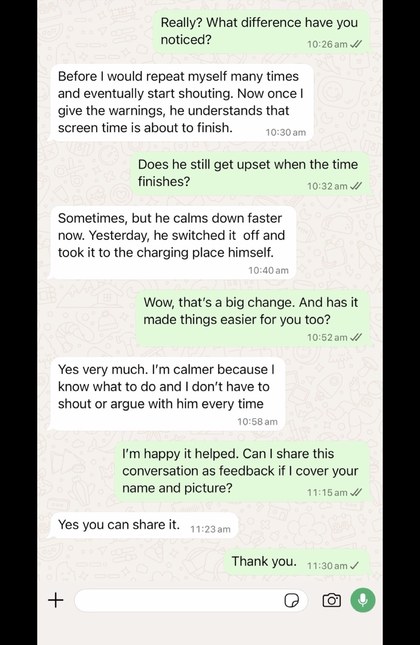
Name and photo removed at her request.
"The first day was not easy, he cried when I told him time was up. But I continued, and by the third and fourth day he already understood what the warnings meant. The crying became shorter, and he started giving me the tablet. The part that helped him the most is where he gets to choose whether to hand it to me or put it at the charging place. I think having that choice made him feel better."
- A parent I shared the method with, shared with permission
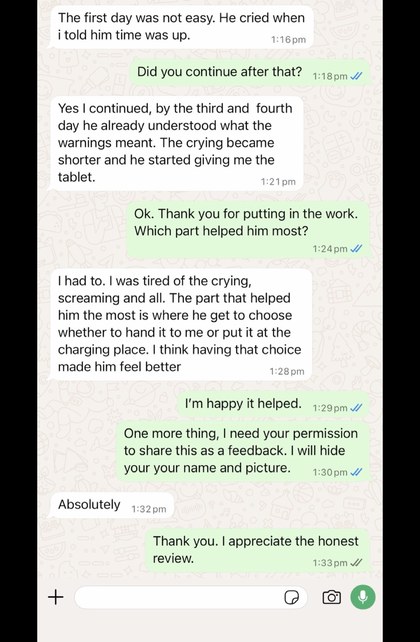
Name and photo removed at her request.
Now available
The 3-2-1 Screen Switch™
How to Reduce Screen-Time Screaming and Bargaining Without Shouting, Snatching the Device or Giving In, Within 7 Days
I wrote down everything, the full 3-2-1 sequence, the exact words to say, the mistakes that quietly wreck it, and how to keep it working, in one clear, plain-language guide you can read tonight and use at the very next hand-off.
Inside the guide, you'll learn:
- Why the meltdown really happens, the one thing about a child's brain that explains every screen-time blow-up, so you stop fighting the wrong problem. (Ch. 1)
- The 3 advance signals, exactly what to say and do before the screen ends so the ending never lands as a shock. (Ch. 3-4)
- The 2 handover choices, the simple "give them control" move that stops most bargaining before it starts. (Ch. 5)
- The 1 calming reset, what to move into right after, so there's no empty gap for a tantrum to fill. (Ch. 6)
- The complete 3-2-1 sequence, all of it in one place, as a simple script you can follow word-for-word until it's second nature. (Ch. 6)
- The #1 mistake that makes handovers worse, most parents do it without realizing, and it undoes everything else. (Ch. 2)
- Your first 7 days, laid out day by day, so you always know what to do next and what "progress" actually looks like. (Ch. 3, 8)
- Keeping it working, how to hold the calm once the novelty wears off, and how to handle the harder, longer-standing cases. (Ch. 7-8)
You don't need to buy anything, download an app, or install parental-control software. You use the devices and routine you already have. The only thing that changes is how the screen ends.
Compare That to What Screen Battles Are Already Costing You
Think about what you've already spent trying to fix this, and I don't only mean money.
- Timer apps and "parental control" subscriptions, they cut the screen off, but they don't teach the child how to end it calmly, so the meltdown just happens on schedule.
- Bribes (sweets, extra time, small toys) buy quiet for a day and teach your child that a fuss earns a reward.
- Sticker charts and reward systems, great in theory, but they don't touch the actual moment of the hand-off, which is where it all falls apart.
- And the real cost, the one nobody puts a number on: the tense evenings, the guilt after you snap, and those minutes every day where you stop enjoying your own child. That's the one this guide is really about.
How Much Is the Guide?
The guide plus the three bonus tools would fairly sell for around $30 as a set, and honestly, weighed against months of nightly screen battles, it would still be worth it at that.
But I didn't write this to price parents out. I wrote it because it genuinely helped the people I love, and I want it to reach the parents who are quietly having the hardest evenings. So the everyday price is $15.99 for the complete package, guide and all three bonuses.
For a limited time, you can get the whole thing at the launch price below.
What Happens After You Click
- You're taken to a secure Payhip checkout page. Pay by card or PayPal, whichever you prefer, it takes under a minute.
- Your payment is confirmed instantly. No waiting for anyone to reply.
- The guide and all three bonuses are delivered to your email straight away, as clean PDFs you can read on your phone, tablet, or laptop, and print if you like.
It's me, Mariam, on the other side of this. Once your payment goes through, everything is yours to keep, forever, on any device.
Three Free Bonuses Included Today
These are the practical, printable tools I built to make the method effortless to actually run, the parts you'll want next to you at the hand-off. They come free with the guide.
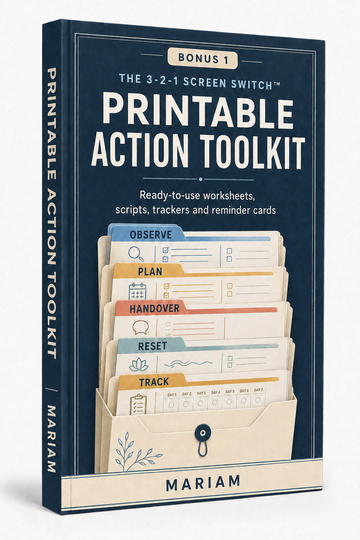
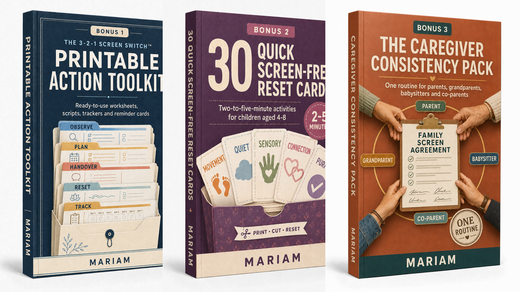
The 3-2-1 Screen Switch Printable Action Toolkit
The whole method on paper: the sequence, the exact phrases, and the day-by-day plan laid out as printable pages you can stick on the fridge. So you're never guessing what to say in the moment, it's right there in front of you.
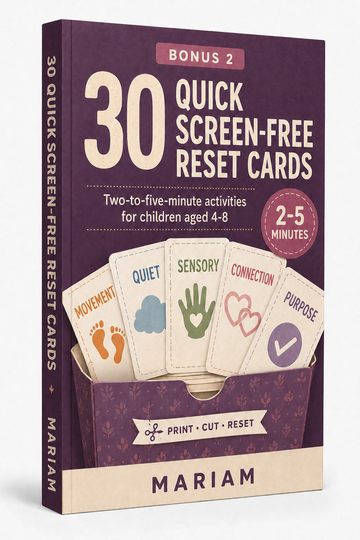
30 Quick Screen-Free Reset Cards
Thirty simple, ready-to-use two-to-five-minute "landing" activities for the calming reset, sorted into movement, quiet, sensory, connection and purpose. This is the something-to-move-into that stops the screenless gap from turning into a tantrum. Print them, keep them handy, and you'll never be caught empty-handed at the hand-off.
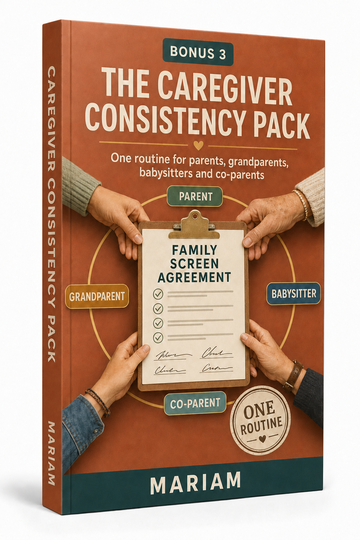
The Caregiver Consistency Pack
A short, shareable guide so everyone who looks after your child (your partner, a grandparent, a nanny) runs the exact same handover the exact same way. Because the method works best when it's consistent, and this makes it easy to get everyone on the same page.
Everything You Get Today
+
- The 3-2-1 Screen Switch (main guide)
$15.99 - Bonus 1, Printable Action Toolkit
$12 - Bonus 2, 30 Quick Screen-Free Reset Cards
$8 - Bonus 3, Caregiver Consistency Pack
$10
Right Now, You Have Two Choices
Change nothing
- Tonight's hand-off ends the way it always does.
- You keep swinging between shouting, snatching, and giving in.
- A month from now, you're still here, dreading it.
Try the 3-2-1 Switch
- You start at the very next hand-off, tonight.
- You finally know the exact words to say.
- The tears shrink to grumbles, then to nothing.
Picture yourself one month from today. The show ends, and your child hands the tablet over, maybe with a small grumble, and moves on. You didn't raise your voice, wrestle it away, or cave. Your evenings feel lighter, and bedtime comes easier because it didn't start with a fight.
The difference between that evening and the one you have now is one small decision, and it starts with the very next hand-off.
P.S. Everything is delivered instantly by email as PDFs you keep forever. The current launch price is $11.99, and it will return to $15.99 after the introductory offer ends.
With warmth, from one parent to another,
Mariam
Questions Parents Ask
How do I get the guide after I pay?
The moment your payment is confirmed on Payhip, the guide and all three bonuses are sent to your email as PDFs, and you can also download them right away. They're yours to keep on any device.
My child is really strong-willed. Long meltdowns, every day. Will this still help?
The method was built for exactly those hand-offs, the ones that reliably end in tears. Stronger, longer-standing patterns can take a little more than a week to settle, and the guide has a section specifically for the harder cases. The core idea is the same: give the ending a runway so it stops arriving as a shock.
What age is this for?
It's written for parents of children roughly aged 4 to 8, which is where screen-time hand-offs tend to blow up the most. Many parents adapt the same three-part sequence up and down a bit from there.
Do I need to buy an app or any special equipment?
No. Nothing to install, nothing to buy. You use the devices and routine you already have. The only thing that changes is how the screen ends, the words and the sequence around the hand-off.
What if my partner or my child's grandparents don't do it the same way?
That's exactly why Bonus 3, the Caregiver Consistency Pack, is included, a short, shareable guide so everyone who looks after your child runs the same calm handover the same way. Consistency is what makes it stick.
Why is this different from all the screen-time advice I've already read?
Most advice tells you what to want, "set limits," "be consistent." This gives you the one thing they leave out: the exact sequence and the exact words for the moment the screen actually goes off. That single moment is where the fight lives, and it's the whole focus of this guide.